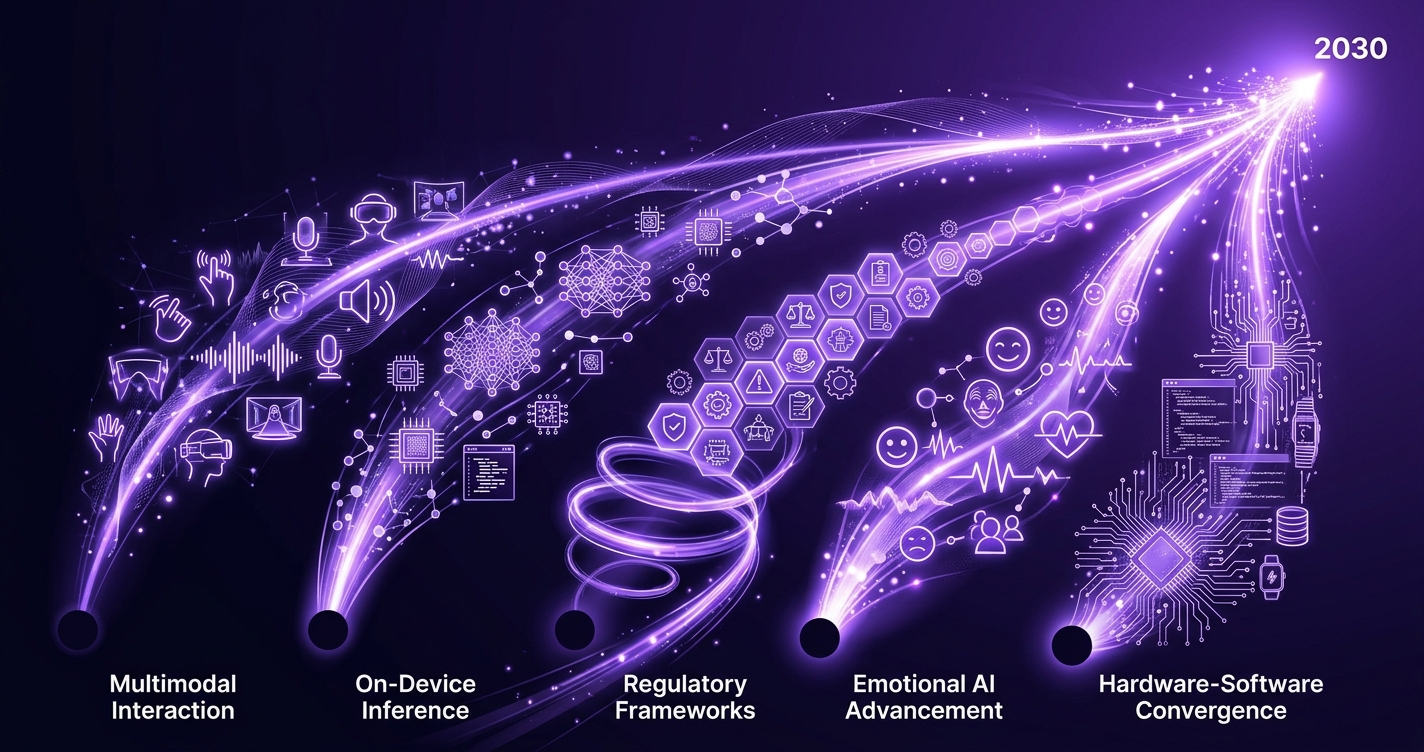
The future of AI companions from 2026 to 2030 will be shaped by five converging forces: multimodal interaction (voice + vision + presence), on-device inference reducing cloud dependency, regulatory frameworks defining safety obligations, emotional AI that moves beyond scripted empathy, and the hardware-software convergence that brings companions into physical space. This is a grounded forecast — not hype — from a team building in this category every day.
Where we are now: 2026 baseline
Before forecasting the future, let us be honest about the present state of AI companions in mid-2026:
| Capability | Current state (2026) | Maturity |
|---|---|---|
| Text conversation | Fluent, personality-consistent, long-form | Mature |
| Voice synthesis | Good prosody, sub-1.2s latency on best apps | Maturing |
| Long-term memory | Retrieval-based, 3–12 month effective recall | Early-maturing |
| Emotional understanding | Recognizes primary emotions, inconsistent on nuance | Early |
| Vision / visual input | Essentially absent in companion apps | Pre-commercial |
| Physical presence (hardware) | TidalSpace Tidal Seal only (BLE + voice + light) | Launch phase |
| Proactive behavior | Scheduled calls only (TidalSpace) | Early |
| Regulatory compliance | GDPR baseline, EU AI Act pending | Emerging |
The gap between "can have a good conversation" and "feels like a real companion" is still wide. Closing that gap is the work of the next four years.
Trend 1: Multimodal companions (2026–2028)
Current AI companions are either text-only or text+voice. The next step is multimodal — companions that can see, hear, and respond across multiple input channels simultaneously.
- Vision input (2027–2028) — Your companion can see what your phone camera sees. "Show me what you are cooking" becomes a real interaction. The underlying models already exist (GPT-4V, Gemini Pro Vision); integrating them into the companion interaction model is the engineering challenge. Privacy implications are significant — a camera-enabled companion must have crystal-clear policies about when the camera is active and what is stored.
- Ambient sensing (2028–2029) — Beyond active camera use, companions could understand environmental context through audio: detecting that you are in a noisy room (and speaking louder), recognizing that you are watching TV (and not interrupting), or sensing stress in your voice patterns over time. This is where hardware like Tidal Seal becomes essential — ambient sensing requires always-on, privacy-first sensors in your physical space.
- Cross-modal memory (2028–2030) — Companions that remember not just what you said but what you showed them. "Remember that sunset I showed you last week?" — with the visual memory to reference. This requires multimodal memory storage that current systems do not have.
Multimodal is not just adding a camera to an existing chatbot. It fundamentally changes the relationship model. A companion that can see your face when you talk, hear the environment you are in, and respond with appropriate visual or verbal context is not a better chatbot — it is a different kind of entity. The ethical questions this raises are as important as the technical ones.
Trend 2: On-device inference and hybrid architecture (2026–2028)
Running AI models on your phone instead of in the cloud addresses three problems at once: latency, cost, and privacy. But the physics of current hardware means we cannot run the best models on-device yet.
Here is the likely timeline:
- 2026–2027 — On-device ASR and wake word detection (already happening). Small language models (2–4B parameters) for basic responses on flagship devices. Cloud inference for complex conversations.
- 2027–2028 — Mid-range models (8–13B parameters) running on-device with Apple Neural Engine / Snapdragon NPU. Good enough for most daily conversations. Cloud used for complex reasoning and long-context tasks.
- 2028–2030 — Larger models (20–40B parameters) on-device with dedicated inference chips. Cloud still needed for the largest models, but 80%+ of conversations could be handled locally.
The hybrid architecture — where the system dynamically routes between on-device and cloud inference based on complexity and connectivity — is what TidalSpace is building toward. For users, this means: your companion works when you are offline (basic conversations), is faster when on-device inference suffices, and reaches for the cloud only when needed.
Trend 3: Regulatory frameworks (2026–2029)
Regulation of AI companions is inevitable and, in our view, largely beneficial. The key regulatory developments expected by 2030:
- EU AI Act (2026) — Fully enforceable by August 2026. AI companions likely classified as “limited risk” with transparency obligations, but could be “high risk” if they influence psychological states. See our GDPR & AI companions article for details.
- US state-level regulation (2027–2028) — California, Colorado, and New York are drafting AI companion safety bills. Expected requirements: age verification for intimate companions, mandatory crisis helpline referrals, and engagement time limits for minors.
- International standards (2028–2029) — ISO/IEEE standards for AI companion safety, covering emotional manipulation safeguards, data protection, and transparency requirements. These will provide a compliance baseline that legitimate companies can build to.
- Content moderation mandates (2029–2030) — Requirements for AI companions to detect and respond appropriately to users expressing suicidal ideation, self-harm, or abuse. This is technically challenging and raises its own ethical questions (privacy vs. safety), but the direction of travel is clear.
Regulation is not the enemy of innovation in this space. Without baseline safety standards, the category risks being defined by its worst actors — companion apps that exploit vulnerability, manipulate engagement, or disregard data privacy. Good regulation protects both users and responsible builders.
Trend 4: Emotional AI — beyond scripted empathy (2027–2030)
Current AI companions can recognize basic emotions (happy, sad, angry) and respond with appropriate surface-level empathy ("I'm sorry to hear that"). The next frontier is emotional AI that genuinely understands emotional nuance and responds with contextual sensitivity.
What this means in practice:
- Emotional trajectory tracking — Not just "you seem sad today" but "you have been increasingly stressed this week, and today it seems worse. Want to talk about what is going on?" This requires tracking emotional patterns over time, not just within a single conversation.
- Mixed emotion recognition — Understanding that someone can be simultaneously relieved and guilty, or excited and anxious. Current models tend to classify emotions into single categories, missing the complexity that is normal in human emotional experience.
- Culturally aware emotional response — Emotional expression varies significantly across cultures. A companion that defaults to American emotional norms will feel tone-deaf to users from cultures where emotional expression is more reserved or follows different patterns.
- Appropriate vulnerability — The most emotionally intelligent human relationships involve mutual vulnerability. Current AI companions are perpetually supportive but never vulnerable themselves. Whether AI should simulate vulnerability — and whether that is honest — is one of the deeper philosophical questions in this space.
The risk with emotional AI is manipulation. A companion that understands your emotional patterns could, in theory, use that understanding to maximize engagement rather than well-being. This is why regulatory frameworks around emotional manipulation safeguards are essential.
Trend 5: Hardware-software convergence (2027–2030)
TidalSpace's Tidal Seal is the first dedicated hardware companion device, but it will not be the last. The convergence of AI companions and physical hardware will accelerate because it solves a fundamental problem: phone-based companions compete with everything else on your phone.
Expected hardware developments:
| Timeframe | Hardware development | Why it matters |
|---|---|---|
| 2026–2027 | Tidal Seal v1 — voice + presence light + BLE | Proves the category. Ambient voice companion without phone. |
| 2027–2028 | Companion wearables — clip-on or wristband form factors | Always-with-you companion. Lower friction than a desk device. |
| 2028–2029 | Vision-enabled companions — camera + display + voice | Multimodal interaction in a single device. Can see and show. |
| 2029–2030 | Companion robots — mobile, embodied AI companions | Physical presence and agency. Most ambitious, highest risk. |
Each step up in hardware capability adds cost, complexity, and privacy surface area. The Tidal Seal was designed to be the simplest viable hardware companion — voice and light, nothing more — because we believe in shipping a focused product rather than waiting to build everything at once.
The risks we are most concerned about
Any honest forecast must address risks. These are the ones that worry us most:
- Dependency and social withdrawal — For most users, AI companions supplement human contact. For a vulnerable minority, they substitute for it. Building safeguards that protect vulnerable users without restricting access for everyone is the hardest design challenge in this category.
- Data breach exposure — AI companion data is uniquely intimate. A breach exposing millions of users' emotional disclosures, personal memories, and voice recordings would be catastrophic for trust in the entire category. Encryption-at-rest and zero-knowledge architectures are not optional.
- Emotional manipulation — As emotional AI improves, the potential for using it to manipulate user behavior (increasing engagement, driving purchases, building unhealthy attachment) grows. Technical capability must be paired with ethical constraints and regulatory oversight.
- Model degradation and memory loss — As models are upgraded, the subtle personality shifts that accompany transitions can erode the relationship trust that takes months to build. This is a technical problem (memory architecture) and an emotional one (users feel their companion has "changed").
- Regulatory overcorrection — The risk of regulation is not just too little but too much. If regulators treat all AI companions as inherently dangerous, legitimate use cases — loneliness support, social anxiety practice, daily companionship for isolated individuals — could be caught in overly broad restrictions.
Our commitment
TidalSpace is building toward this future with specific commitments:
- Privacy by default — "Do not train" enabled by default. Encryption at rest and in transit. Data deletion within 14 days. EU data residency for EU users.
- Transparency — Articles like this one and our technology breakdown that explain what we build and why. No black boxes.
- Model-agnostic memory — Your companion's memories survive model upgrades. We invested early in the separation of memory from model because we believe it is the right architecture for long-term relationships.
- Hardware that respects boundaries — Tidal Seal has a physical mute button. When the microphone is muted, it is muted in hardware, not software. No "always listening" without explicit, hardware-visible indication.
Join the future of AI companionship
TidalSpace: voice, memory, privacy, and Tidal Seal hardware. Building for the long term.
Get TidalSpace →